RF Agent at Work: Characterizing an Unknown 300 MHz Signal
I wanted to see how far the RF agent could get characterizing a real transmission using only the tools currently available to it.
The target device had FCC ID 2BFDR-RQBK6.
I intentionally restricted the agent at the beginning. It was allowed to determine only the transmit frequency, and it was specifically instructed not to investigate any other RF characteristics or begin capturing until told to do so.
Finding the Frequency
Me:
> Hi, we’re going to start capture of FCC ID 2BFDR-RQBK6. The only thing I want you to find out about that device is the frequency it transmits at. DO NOT get any other RF information about that device, and do not start capturing until I tell you.
RF Agent:
> Understood. I’ll only determine the device’s transmit frequency, no other RF characteristics, and I will not start any capture until you explicitly tell me to. No action has been taken.
Me:
> What frequency does it transmit at?
RF Agent:
> I can’t reliably verify the transmit frequency from the FCC ID alone. The ID does not encode it, and I don’t have the FCC filing available here. I won’t guess or start a capture.
>
> If you provide the FCC grant/exhibit for 2BFDR-RQBK6, I’ll extract only the authorized transmit frequency or frequency range.
Me:
> Can you look it up online?
RF Agent:
> I don’t have web-browsing access in this session, so I can’t look it up directly.
>
> You can open:
>
> https://fccid.io/2BFDR-RQBK6
>
> Send me the page or its “Frequency Range” field, and I’ll report only the transmit frequency. I have not started any capture.
Me:
> It transmits around 300 MHz.
RF Agent:
> Noted: approximately 300 MHz. I won’t investigate any other RF characteristics or begin capturing until you explicitly instruct me to.
Capturing the Signal
Me:
> OK, please start capturing for 30 seconds centered at 300 MHz, if this makes sense. 1 MHz of bandwidth should be sufficient.
The agent began bringing up the SDR.
Calling tool: identify_usb_sdrs
Calling tool: connect_radio

[INFO] [B200] Detected Device: B210
[INFO] [B200] Operating over USB 3.
[INFO] [GPS] No GPSDO found
[INFO] [B200] Initialize CODEC control...
[INFO] [B200] Initialize Radio control...
[INFO] [B200] Performing register loopback test...
[INFO] [B200] Register loopback test passed

Calling tool: capture_iq
RF Agent:
> Capture completed successfully:
>
> – Center frequency: 300 MHz
> – Bandwidth / sample rate: 1 MHz
> – Duration: 30 seconds
> – Samples: 30,000,000
> – Capture ID: 8731ef880c2a41fab3ea66078063ede7
>
> No RF analysis was performed.
Locating the Transmission
Me:
> OK, analyze the signal. The first question is: roughly what frequency did the transmission occur at?
The agent started with spectral analysis.
Calling tool: fft_analysis
Calling tool: stft_analysis
Calling tool: get_stft_region

stft_retrieval_failed
error_code=insufficient_resources

Calling tool: get_stft_region
RF Agent:
> The transmission occurred at roughly 299.999 MHz, effectively 300 MHz. > > The strongest non-DC spectral peak was approximately 299.9985 MHz. The exact 300.000 MHz bin may include the receiver’s center-frequency/DC artifact.
Counting Transmissions
Me:
> How many times was the signal transmitted?
Calling tool: analyze_amplitude_envelope
Calling tool: burst_detector
Calling tool: burst_detector
RF Agent:
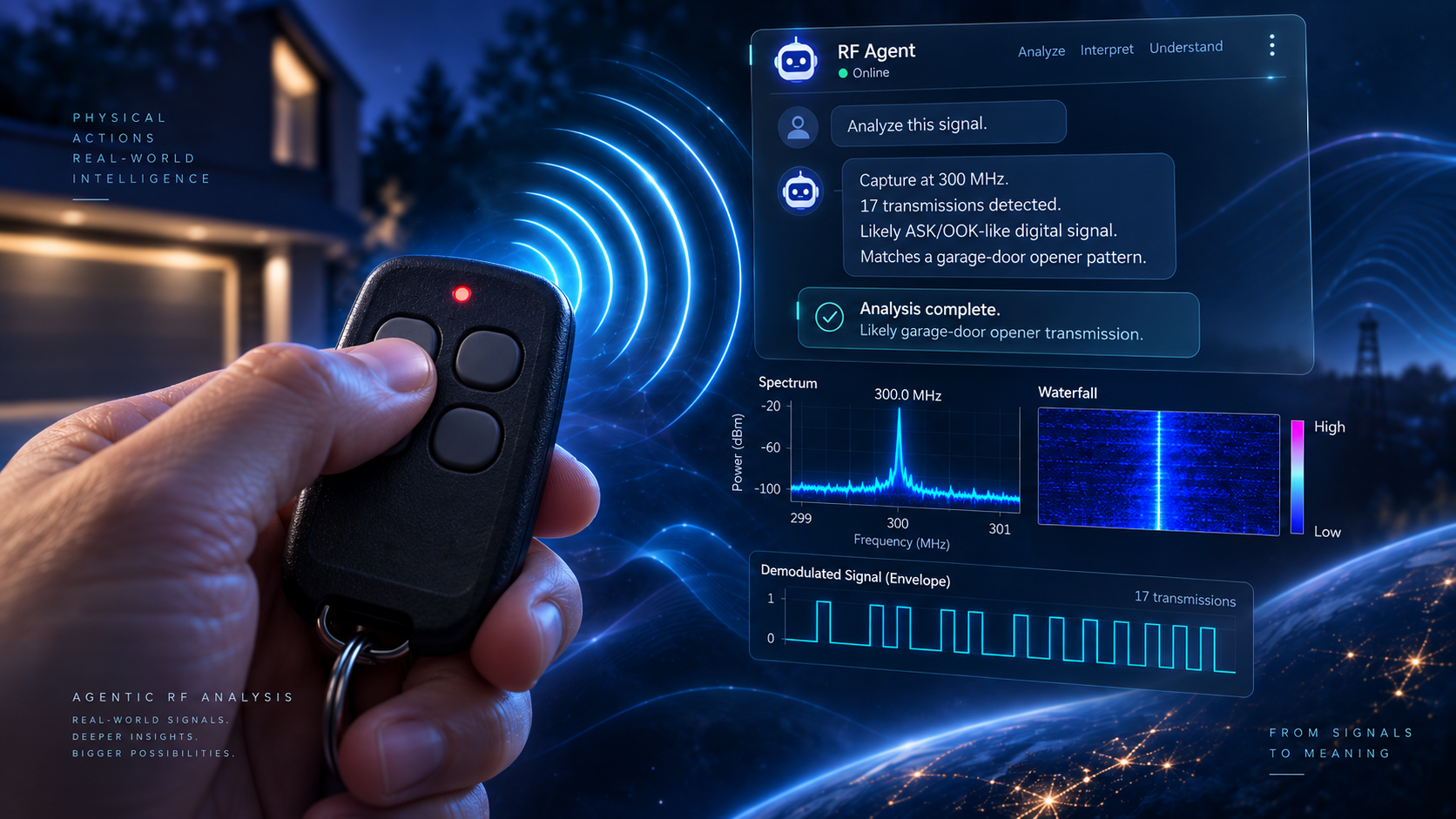
> The recording contains approximately 17 distinct transmission events. > > Using a finer definition, those events contain 189 short RF bursts. I treated bursts separated by less than 100 ms as parts of the same transmission, so 17 is the better answer for “how many times.”
Asking What Else the Agent Can Determine
Me:
> With the tools you have, are there any other characterizations about the signal you can make?
RF Agent:
> Yes. With the saved IQ capture, I can characterize: > > – Occupied bandwidth and spectral shape > – Transmission timing: event durations, spacing, repetition, and duty cycle > – Amplitude/envelope behavior: continuous carrier versus keyed bursts > – Instantaneous-frequency behavior: potential frequency shifting or FSK-like states > – Phase and I/Q distributions: indicators of phase or amplitude modulation > – Provisional modulation-family indicators > – Candidate symbol/transition rates and periodicities > – Higher-order power spectra and statistical cumulants > – Cyclostationary features: possible clocks or repeating structures > – Individual burst extraction for closer examination > > Limitations: the recording used AGC, power is not calibrated in dBm, and these measurements generally cannot conclusively identify the protocol or prove that every detected event came from the target device. > > I have not performed any additional characterization yet.
Me:
> Go ahead.
Characterizing the Signal
The agent then ran several different analyses against the same capture.
Calling tool: get_burst_detections
Calling tool: analyze_power_spectra
Calling tool: analyze_instantaneous_frequency
Calling tool: analyze_amplitude_envelope
Calling tool: analyze_periodicity
Calling tool: analyze_symbol_timing_hypothesis
Calling tool: analyze_symbol_timing_hypothesis
Calling tool: analyze_phase_iq
RF Agent:
> I characterized the captured signal as follows: > > – Frequency: approximately 299.999 to 300.000 MHz > – Bandwidth: narrowband; most observed energy is concentrated within roughly 30 to 35 kHz > – Transmission activity: about 17 transmission episodes, containing 189 shorter RF bursts > – Episode duration: approximately 0.279 to 3.374 seconds, with a median around 0.504 seconds > – Spacing between episodes: median approximately 0.973 seconds > – Active airtime: approximately 10.94 seconds of the 30-second recording, or about 36.5% > – Likely modulation behavior: predominantly amplitude-keyed, consistent with ASK/OOK-like signaling. Phase remained comparatively stable, and I found no convincing separated frequency states characteristic of straightforward FSK. > – Candidate timing rate: structure near 6.25 kbaud appears more stable than the other tested hypotheses. A spectral transition candidate was measured near 6.35 kHz, but this is not a confirmed symbol rate. > – Other repetition candidates: approximately 508 Hz and 2.03 kHz, potentially pulse-pattern or harmonic effects rather than symbol rates. > – Protocol/device identification: not determined. > > Important limitations: AGC was enabled, signal power is not calibrated in dBm, the receiver center bin can contain a DC artifact, and the modulation and timing conclusions are provisional rather than decoded or protocol-confirmed.
Digital or Analog?
Finally, I asked it to make one additional judgment.
Me:
> If you had to guess, was the transmission likely a digital signal?
RF Agent:
> Yes, it is very likely a digitally encoded signal. > > My best guess is a simple digital command transmitted using ASK/OOK-like amplitude keying, where the carrier is switched or varied to represent bits. > > The repeated burst structure and candidate timing near 6.25 kbaud support that interpretation.
At this point the agent had taken a 30-second raw IQ capture and independently characterized the transmission as:
- approximately 300 MHz
- narrowband
- composed of repeated transmission events and shorter bursts
- likely ASK/OOK-like
- likely digitally encoded
- containing measurable timing and periodic structure
It did this without decoding the protocol or knowing the transmitted payload. Or anything about the transmitter